
OMSS Came a Month Early, and the Market Barely Blinked
OMSS came a month early, and the market barely blinked
- On 14 October 2026, FCI opened its first OMSS wheat e-auction of the season, a full month ahead of last year's 12 November start.
- The trigger was price: Delhi (Lawrence Road) wheat stood at ₹3,070/qtl on the first auction day, against ₹2,830/qtl when the 2025 tender opened.
- The early sales were meant to cool the market. Instead, Delhi touched ₹3,090 on 20 October, just before the second tender that followed on 21 October.
- Delhi closed at ₹3,100 on the second auction day, the highest level of the season. Since the OMSS sale was first announced, when Delhi was at ₹2,970, the market has risen by ₹140 as of 22 October.
- The government wheat is being absorbed, not weighing on prices.
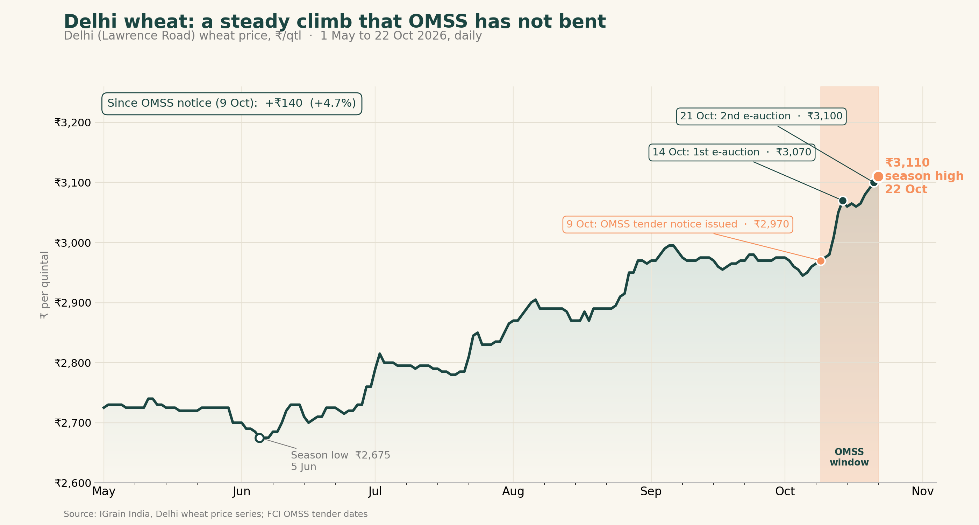
Figure 1. Delhi (Lawrence Road) wheat price, ₹/qtl, 1 May to 22 Oct 2026, daily, with FCI OMSS tender dates. Source: IGrain India
Half the quantity, more wheat lifted than last year
- FCI offered 1.05 LMT on 14 October (first e-auction) and 1.075 LMT on 21 October (second e-auction); buyers lifted 86,245 MT (82%) and 1,00,747 MT (94%) respectively, for a cumulative uptake of 88%.
- In November 2025, the first two sales were put up for 4 LMT and cleared just 1.49 LMT (37%). This year's 1.87 LMT has already outsold that, at a higher reserve price.
- Uptake rose by 12 percentage points between the two auctions, and FCI responded by adding 2,500 MT to the offer rather than trimming it.
- A 37% uptake last year meant mills still had private stock to fall back on. An 88% uptake this year, with prices rising, means that cushion is gone.
- Flour millers, processors and biscuit makers are building festive inventory on empty pipelines, which is why they return each week and pay over reserve.
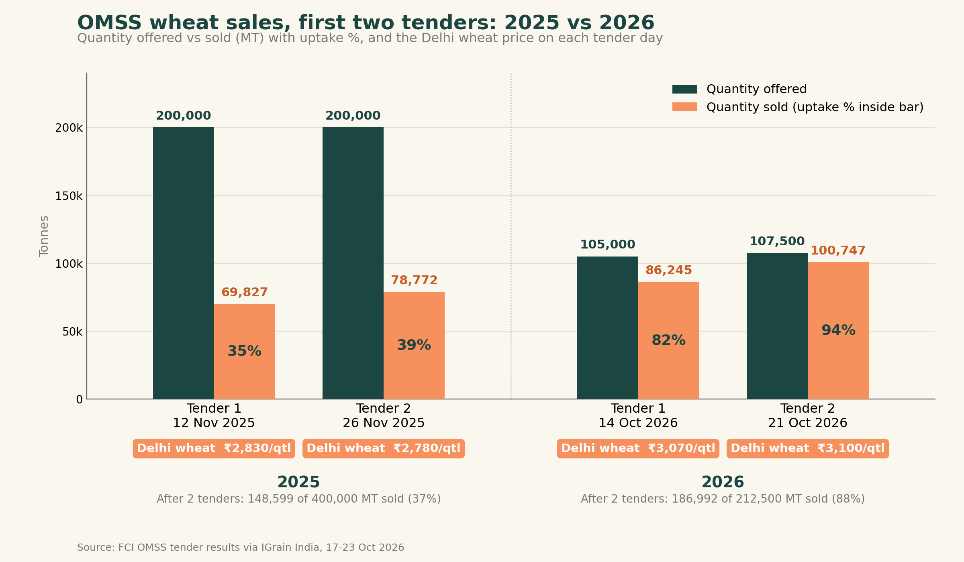
Figure 2. OMSS wheat sales, first two tenders: 2025 vs 2026. Quantity offered vs sold (MT) with uptake %, and the Delhi wheat price on each tender day. Source: FCI OMSS tender results via IGrain India, 17–23 Oct 2026
Millers paid up, not down
- The winning bids tell the demand story better than the volumes, and they got stronger in the second round.
- In Delhi, FAQ wheat carried a reserve of ₹2,679–2,696 per quintal (including transport). It cleared at ₹2,924–2,946 in the first tender and ₹2,950–2,976 in the second, close to ₹280 above the floor.
- Punjab URS wheat, reserved at ₹2,585, sold at ₹2,670–3,090 on 14 October and ₹2,861–3,065 on 21 October. The bottom of the range moved up by nearly ₹200 in a week.
- Haryana, also reserved at ₹2,585, went from ₹2,700–2,870 to ₹2,900–2,990.
- The highest bids came from the deficit southern and western states, where mills have no local crop to fall back on.
- When buyers bid ₹300 over the reserve in the second week of a sale, they are not waiting for cheaper government wheat. They are covering a gap.
The private pipeline is empty
Three major factors drained it.
- Procurement: the government bought more wheat in the 2026 rabi season than the year before, so less of the crop stayed with traders and mills. Last season private availability was comfortable; this season it is not.
- OMSS timing: the gap between the OMSS announcement and the first actual sale on 14 October gave the trade several weeks of drawdown with no replenishment, and prices moved higher in that window.
- Weather: this year's rainfall dented productivity. Layer festive demand on top of that, and the auction results make sense. Farmers and traders hold limited stock, most private inventory is being liquidated, and the mills have nowhere to turn but FCI.
Where the wheat went
- FCI followed the demand. It added 3,000 MT each to Punjab (now 23,000 MT) and Haryana (now 12,000 MT), and more to Delhi, MP, TN and Telangana, where the first round had sold out. Odisha, Bihar, West Bengal, Jharkhand and J&K got less as they lagged during the first tender.
- The wheat belt took it all again. Punjab lifted 22,989 of 23,000 MT and Haryana 11,700 of 12,000 MT. Over two tenders Punjab alone has bought about 43,000 MT, nearly a quarter of all OMSS wheat sold.
- UP and Gujarat caught up. UP went from 79% uptake in round one to 100% in round two (7,989 of 8,000 MT), and Gujarat from 87% to 100% on a larger offer.
- The laggards improved. Odisha went from 22% to 51%, Maharashtra from 51% to 96%, Bihar from 39% to 87%. Only Andhra Pradesh (85% to 60%) and J&K (68% to 50%) slipped.
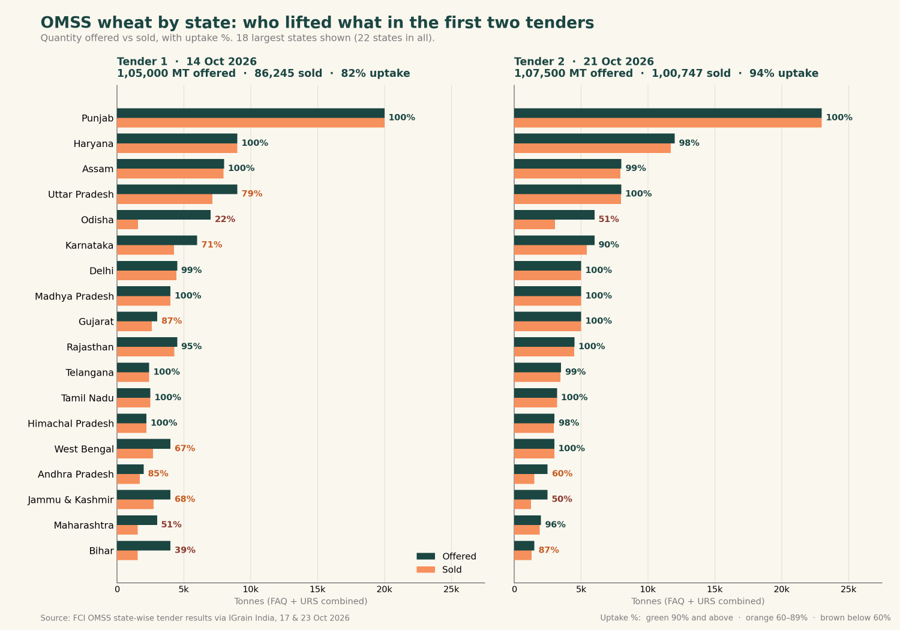
Figure 3. OMSS wheat by state: quantity offered vs sold (FAQ + URS combined) with uptake %, first two tenders. 18 largest states shown (22 states in all). Source: FCI state-wise tender results via IGrain India, 17 and 23 Oct 2026
- When the surplus states clear their full quota twice in a row, it indicates mills in the producing region itself are running short of wheat.
The paradox: record stocks, rising prices
- This is not a supply shortage at the national level. Central pool wheat stood at about 465 lakh tonnes on 1 October 2026, up from 320 lakh tonnes a year earlier and 238 lakh tonnes in October 2024.
- The government has more wheat in hand than at any point in three years.
- The pressure is in the private pipeline. This year's rainfall dented productivity, trade stocks have been sold down, and the FCI release pace of about 1 lakh tonnes a week is modest against festive demand.
- Imports won't ease the pressure either. US wheat exports this season are near 7.3 million tonnes, 65% below last year's pace, so cheap global wheat is not on offer.
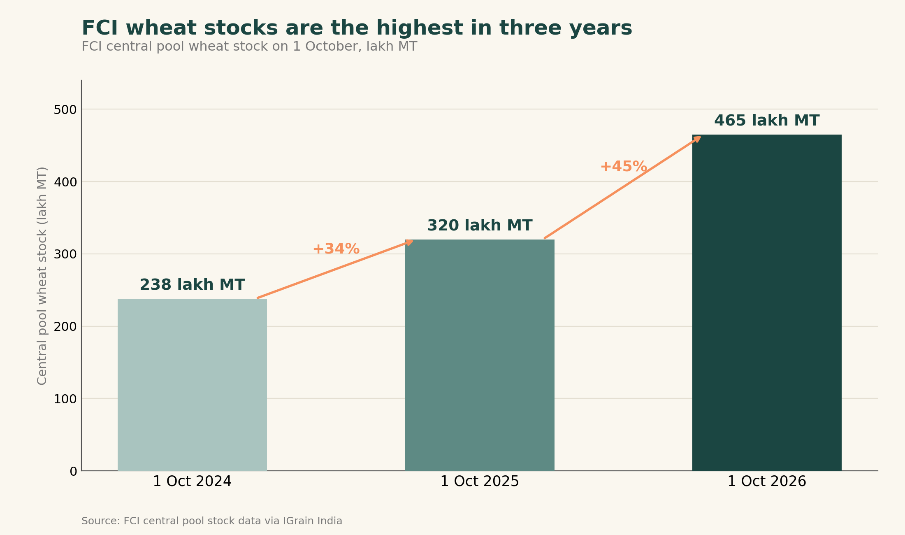
Figure 4. FCI central pool wheat stock on 1 October, lakh MT. Source: FCI central pool stock data via IGrain India
What to watch next
- The OMSS quantity is the swing factor. Unless the weekly offer is raised significantly, the supply-demand gap persists and the market stays bullish.
- With quantities unchanged, Delhi testing ₹3,200 looks likely.
- Early acreage reports will show how much wheat the government can release without discouraging farmers at planting time.
- If buyers keep lifting more than 90% of what is offered at ₹100 plus over reserve, demand is not fading.
- The early OMSS start was the right call; it bought time. The next call, on how much to release and when, will set the tone for wheat through the winter.