
Spice Exports Fall 26%. Turmeric Holds
Spice exports: volumes slipped, earnings climbed
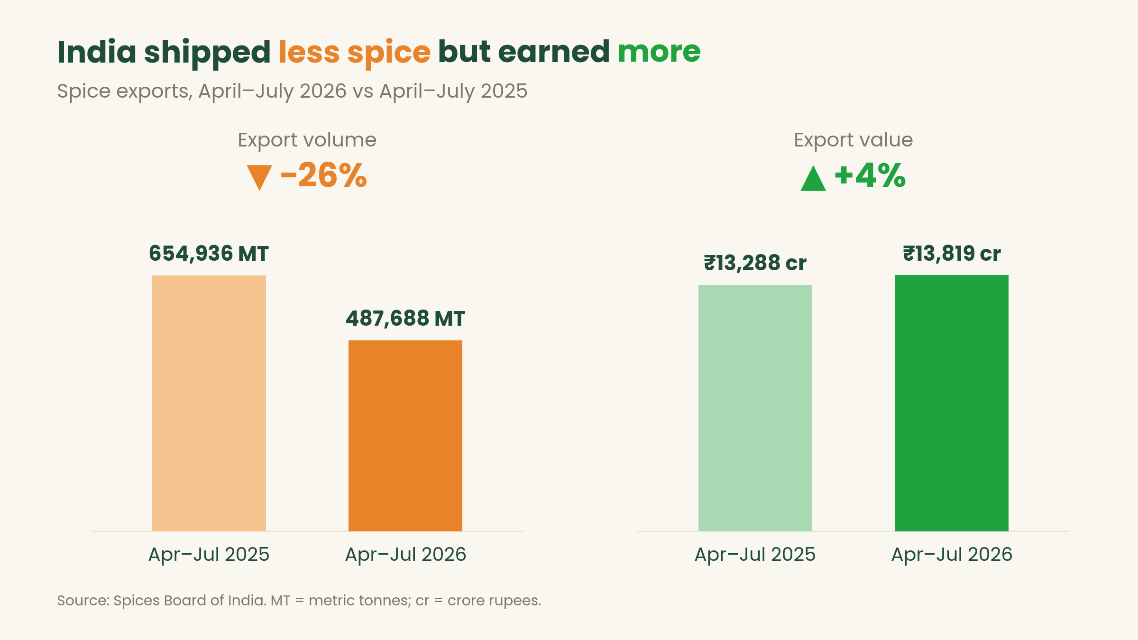
- India shipped 26% less spice by volume during April–July 2026 but earned 4% more.
- Spices Board data for April–July 2026 puts exports at 4,87,688 MT against 6,54,936 MT a year earlier, while value rose to Rs.13,819 crore from Rs.13,288 crore (↑4%).
- The gap comes from firmer export offer prices and a weaker rupee, which lifted the rupee value of every dollar earned.
Source: Spices Board of India
Turmeric: the outlier in India’s spice exports
Source: Spices Board of India
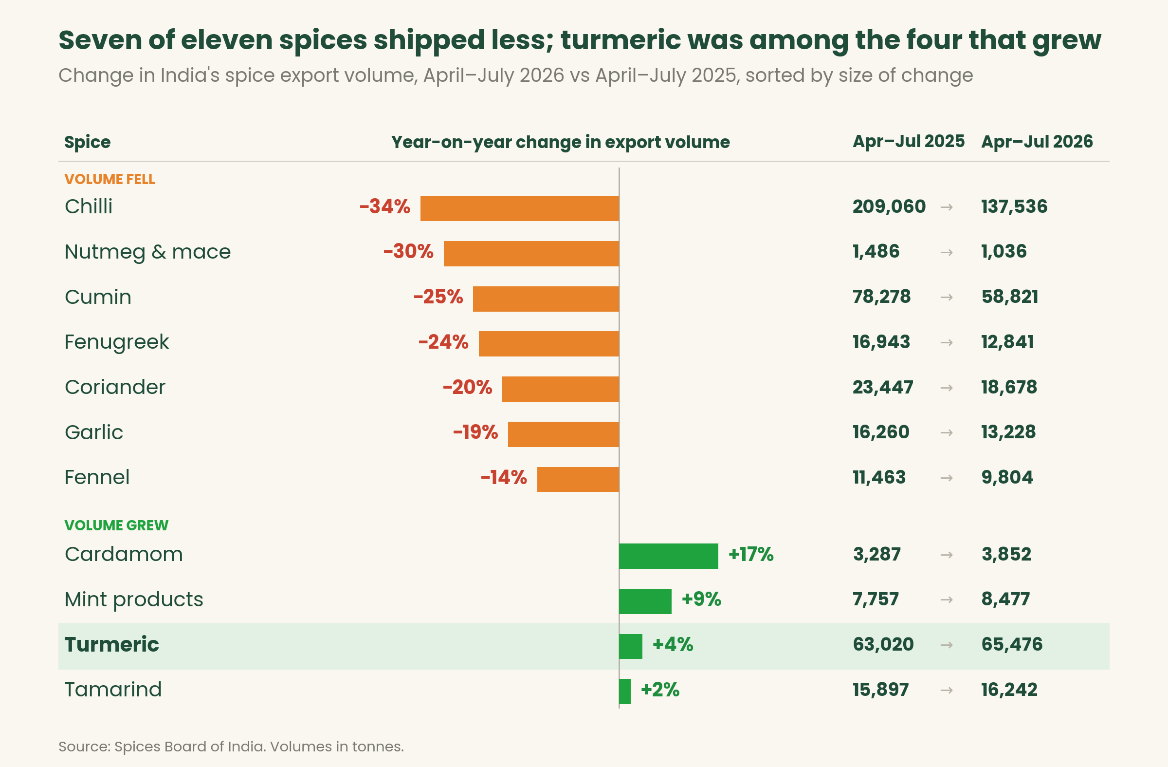
- FY25 saw cumin prices correct sharply from their 2023 peak of Rs.65,000/qtl to Rs.23,500/qtl, pulling record volumes out of India, so a 25% dip against that base is normalisation rather than collapse.
- Of the spices that recorded year-on-year volume growth, turmeric saw the largest absolute increase.
- In a quarter when buyers cut back almost everywhere else, turmeric demand held strong. That resilience reflects the cycle turmeric is coming out of.
- The 2023 El Niño monsoon deficit pushed turmeric past Rs.18,000/qtl in 2024, the highest in over a decade. The larger 2025 and 2026 harvests then brought prices down to levels at which overseas buyers restocked.
The changing geography of turmeric demand
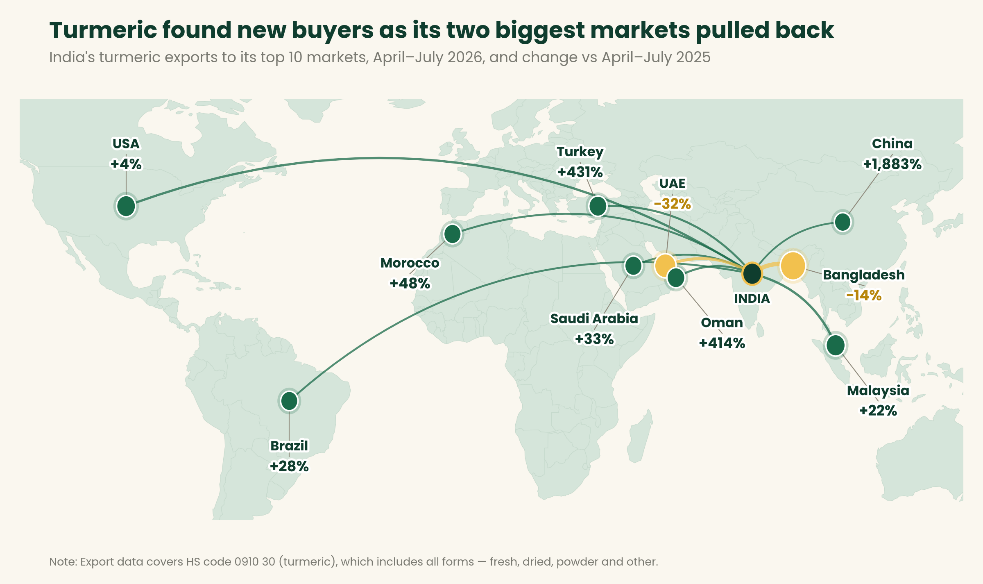
- Turmeric’s export growth was driven by Turkey (+2,441 MT), Oman (+2,345 MT) and China (+2,128 MT), with solid gains in Morocco, Saudi Arabia, Brazil and Malaysia, mostly for dried turmeric and turmeric powder.
- The two largest markets fell: the UAE (−2,480 MT), largely re-export trade shifting to Oman, and Bangladesh (−1,459 MT).
- Turmeric’s export growth continued through June, but the trend reversed in July. Exports fell 10% compared to July 2025, suggesting buyers started pulling back as Indian prices firmed up.
Source: DGCI&S trade data
El Niño and the 2027 turmeric supply squeeze
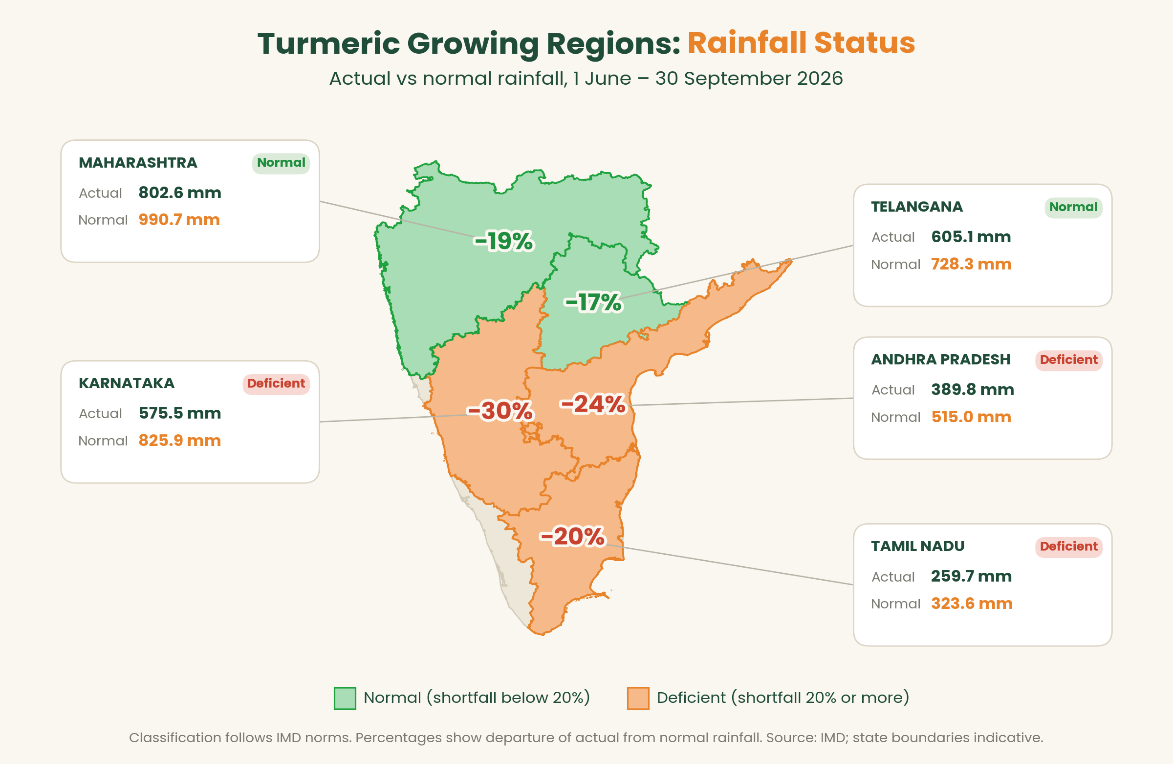
- Monsoon shortfalls have hit the standing crop across all five major turmeric states. Karnataka, Andhra Pradesh and Tamil Nadu are in deficit, while Maharashtra and Telangana sit just above the threshold.
- Supply is expected to stay broadly in line with demand through the rest of 2026, cushioned by stocks from the last two larger crops.
- The squeeze arrives in 2027. Turmeric is a 7-to-9-month kharif crop, planted in June–August with the monsoon and harvested in January–April. A weak monsoon now means a thin harvest then, and rainfed fields are the most exposed.
- The outlook for growth in India’s turmeric exports has already been cut to 10–15% from 20–25%, purely on lower production prospects.
Source: IMD
- Turmeric in these five states is largely irrigated. A weak monsoon does not hurt the crop directly. It hurts by leaving less water in the borewells and canals that farmers depend on, right when the crop needs the most water, from September to December (during rhizome bulking).
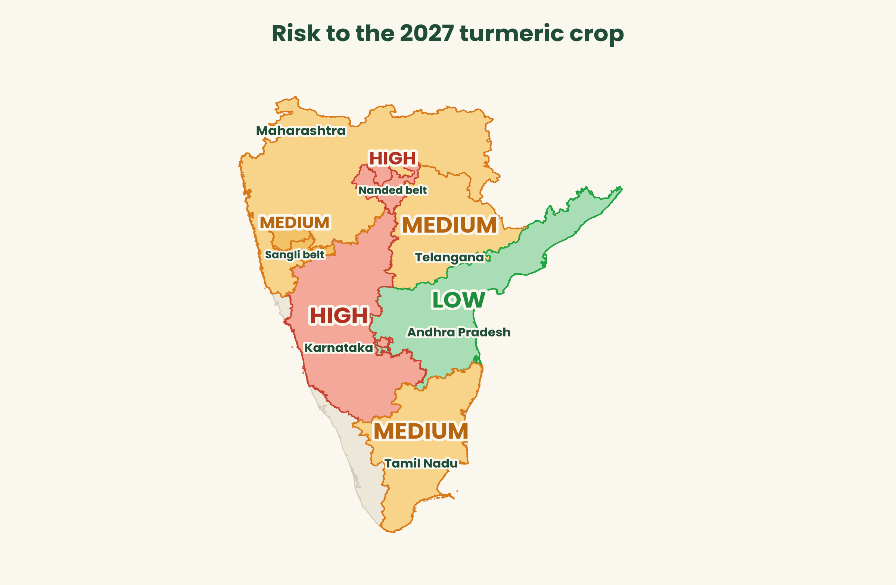
- Karnataka is worst placed, as the deepest deficit has left groundwater and reservoirs short, and farmers who resowed after losing the early crop have seen the second sowing damaged too.
- Maharashtra is divided: the borewell-fed Nanded belt is at risk, while Sangli and Satara on dam-fed canals and drip are secure.
- Tamil Nadu’s dams and canals have not recharged, leaving the crop exposed until the north-east monsoon.
- Telangana could go either way, with Nizamabad’s outcome resting on Sriram Sagar storage.
- Andhra Pradesh’s Duggirala belt is canal-fed from the Krishna delta, and farmers report no impact as of now.
- Improved rainfall across the south in early October may limit further losses but cannot recover what is already lost.
Why turmeric matters beyond the spice aisle
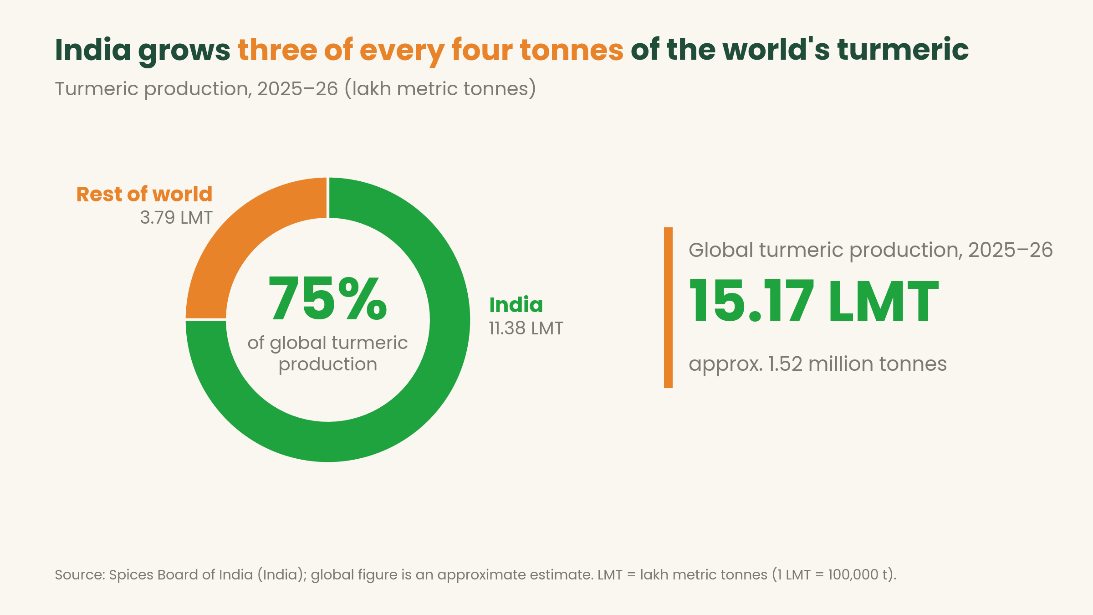
- A weak Indian turmeric crop is a global supply event, not a regional one. India grows roughly 75% of the world’s turmeric and holds over 60% of world trade in it.
- There is a recent precedent. The 2023 El Niño monsoon ended at roughly 94% of normal with a record-dry August, and the thin 2024 harvest pushed turmeric to its highest level in more than a decade. Prices only eased through 2025, once higher acreage brought a bigger crop to market.
Source: Spices Board of India
- Demand, meanwhile, is structurally rising. Curcumin extraction for nutraceuticals, pharmaceuticals and cosmetics is growing faster than culinary use.
- Turmeric in 2027 will be its stress test. A smaller crop should hold prices firm and lift realisation, but only if buyers absorb the increase rather than switching origins, substituting curcumin sources or deferring purchases.
- The 2024 spike showed that buyers will pay up when there is no alternative. It also showed how quickly they return to volume buying once prices fall, which is exactly what the Q1 turmeric export number reflects.
- The turmeric market has already turned bullish. Spot prices at Nizamabad and Sangli rose Rs.7–10/kg in a single week to Rs.17,000–18,000/qtl, the highest since the 2024 El Niño spike.
- Turmeric held up when the rest of India’s spice exports fell. Whether it can hold up when the crop itself shrinks is the question 2027 will answer.