
Maize Breaks Records in the South and West. The Heartland Hasn't Followed, Yet

Key numbers
- ₹3,255 per quintal at Warangal, Telangana, a market record (29 Oct).
- 232 lakh tonnes: kharif 2026 maize crop estimate, down 16.8% (CLFMA).
- 10 MMT of maize used for ethanol in 2024-25, up from 0.5 MMT in 2017-18.
- 1.04 lakh tonnes of Myanmar maize booked for Nov–Dec loading, 1.8× all of FY26's imports.
Records in the South and West, softness in the East
Maize sold at ₹3,255 a quintal at Warangal's Enumamula market on 29 October, which local traders called a record for the market. On FarMart's Rapid Trade platform on 30 October, feed millers in Coimbatore bid ₹3,400–3,450, buyers in Maharashtra ₹2,850–3,070, and single bids in Karnal and Muzaffarpur stood at ₹3,000 and ₹2,950. All of these are above the 2024-25 peak of ₹2,728 at Gulabbagh, eastern India's benchmark market.
The picture is very different where the new crop is arriving. Saharsa in Bihar traded at ₹1,900–2,000 and Gulabbagh at ₹2,600–2,700. The all-India average mandi price on 16 October was ₹2,210, about 8% below the ₹2,410 MSP, because wet new-crop grain is selling at a discount. Year on year, though, the move is large everywhere: Pratapgarh in Rajasthan trades at ₹2,500–2,800 against ₹1,500–1,700 last year, and distillers say they now pay about ₹27 a kg against ₹17–18 a year ago.
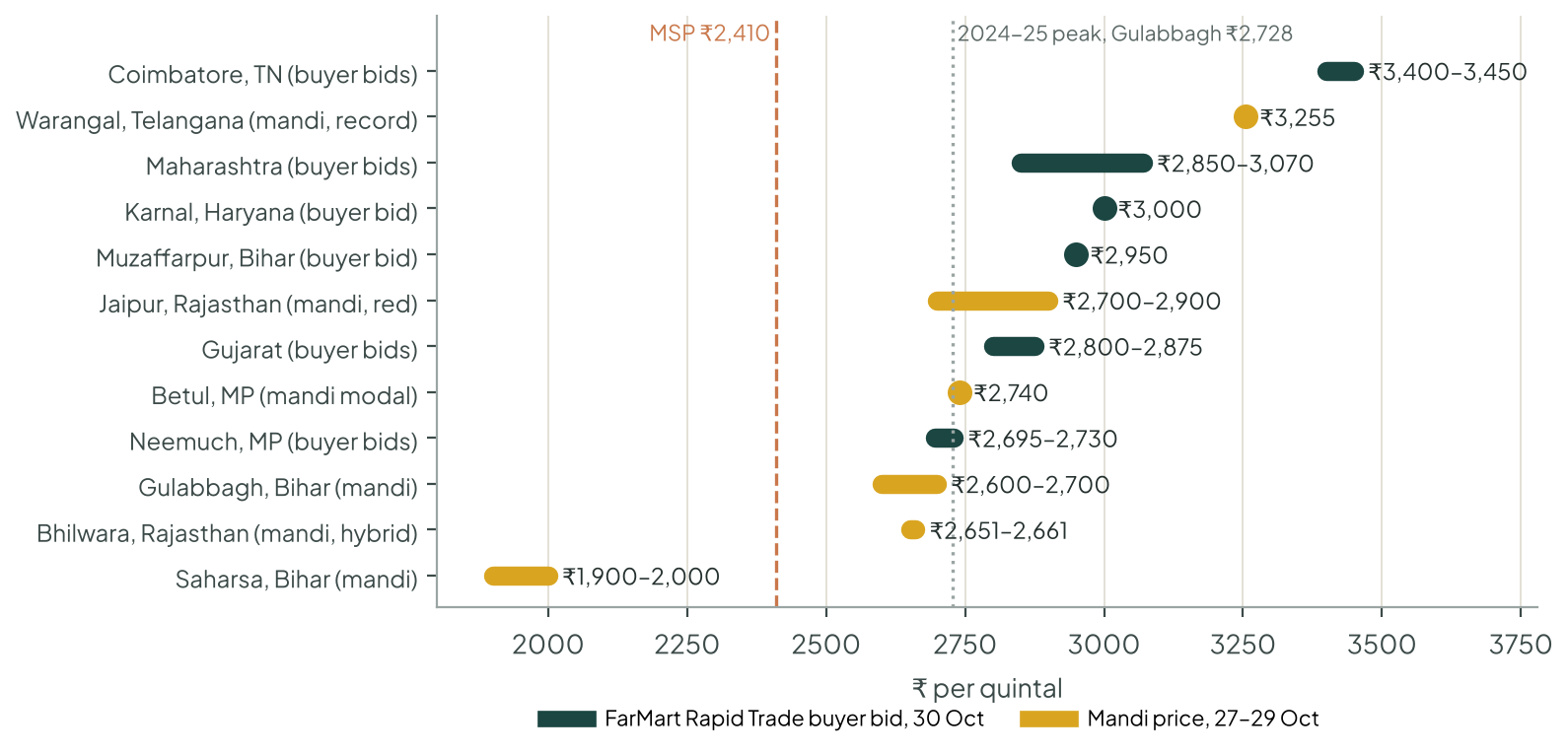
Figure 1. Maize prices by market, late October 2026 (₹/quintal). Buyer bids: FarMart Rapid Trade (TradX), live bids on 30 Oct 2026. Mandi prices: Andhra Jyothy (Warangal), Dainik Bhaskar (Jaipur), Betul Update (Betul), Prabhat Khabar (Gulabbagh, Saharsa), News18 (Bhilwara), 27–29 Oct 2026. Peak: Agmarknet, Gulabbagh weekly series.
A V-shaped year for maize prices
The all-India average mandi price peaked at ₹2,414 in February 2025, then fell to ₹1,812 in March 2026, 25% below MSP, after a large 2025 crop. It has since climbed 33% to ₹2,410 in October 2026, level with MSP and with the February 2025 peak. The national average is not yet at a record; the records are in markets where the crop failed. Central India swung harder: Chhindwara (MP) fell to ₹1,573 in February 2026 and recovered to ₹2,470 by September.
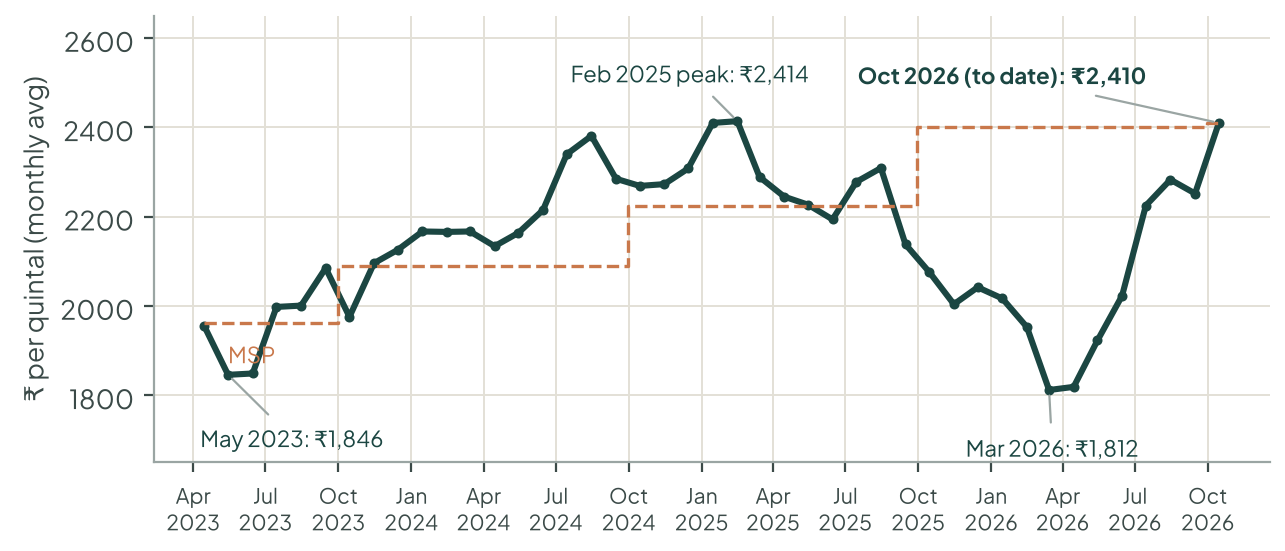
Figure 2. All-India maize, monthly average mandi price vs MSP, April 2023 to October 2026 (₹/quintal). Agmarknet monthly state prices, simple average of 11 major states (AP, Chhattisgarh, Gujarat, Karnataka, MP, Maharashtra, Odisha, Rajasthan, Tamil Nadu, Telangana, UP); October 2026 is month to date as published on 30 Oct 2026. CACP kharif MSP by marketing year.
Over a longer horizon, MSP has risen 2.7 times since 2010-11, from ₹880 to ₹2,410. Today's buyer bids of ₹2,700–3,070 in most markets sit above every annual all-India average in our series.
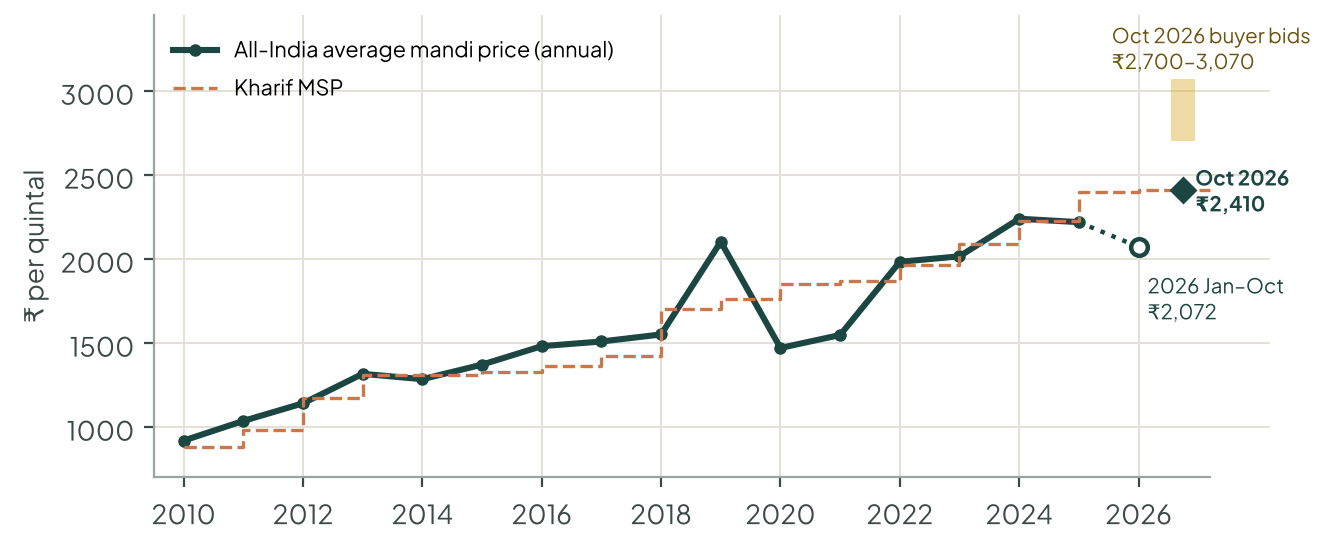
Figure 3. All-India maize price and MSP since 2010 (₹/quintal). Agmarknet: all-India monthly averages 2010–2019 (2019 contains a data spike under review); from 2020, simple average of 11 major states' monthly prices, October 2026 month to date. CACP MSP. Buyer-bid band: FarMart Rapid Trade, 30 Oct.
The supply hole is in the South and West
The livestock feed industry body CLFMA puts the kharif 2026 maize crop at 232.09 lakh tonnes, 16.75% lower than last year, on 9% less area (89.06 lakh ha). The losses are concentrated: Karnataka is estimated at 34 lakh tonnes (down 33%) and Maharashtra at 22.8 lakh tonnes (down 24%), both hit by drought. The Agriculture Ministry's sowing data (2 October) show 93.54 lakh ha against 96.34 lakh ha a year ago.
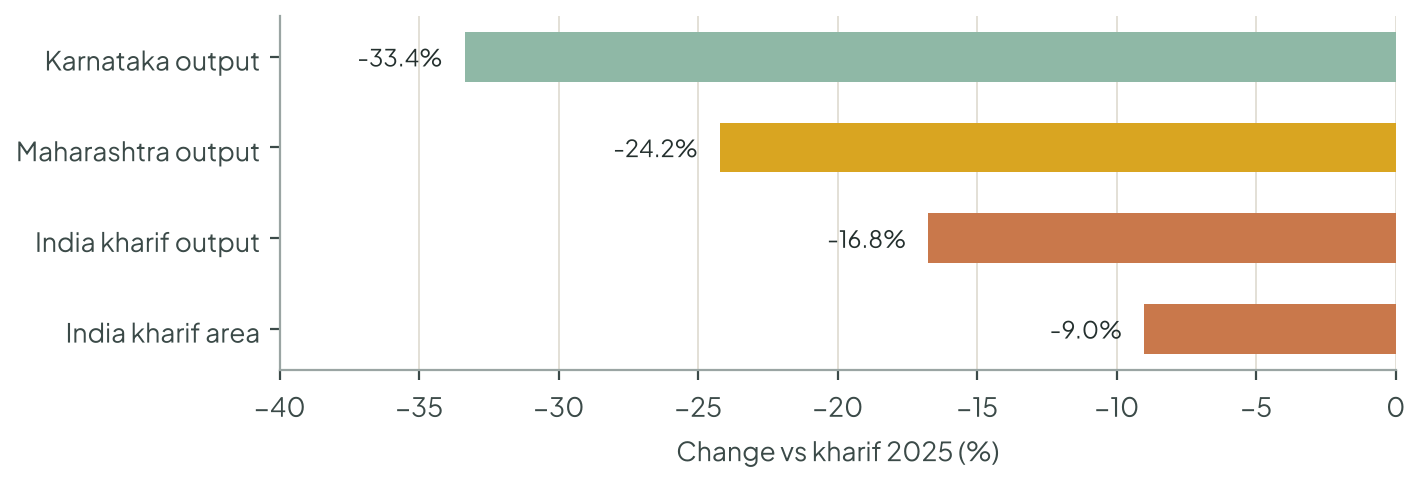
Figure 4. Kharif 2026 maize, change vs last year. CLFMA kharif 2026 estimate, as reported by BusinessLine, 23 Oct 2026 (industry estimate, not an official figure).
Madhya Pradesh and Rajasthan, by contrast, have a big crop. Guna mandi received 65,476 quintals in a single day on 27 October, its highest in five years, and Sironj took a record 30,000 quintals. Begun mandi in Chittorgarh is sending about 750 tonnes a day to Gujarat, Punjab and Maharashtra. Grain is flowing from the surplus belt to the deficit states, but not fast enough to close the gap: MP mandis are near ₹2,740 while Tamil Nadu bids are ₹650–700 higher.
From exporter to importer, and back again
India's maize trade has swung hard in four years. In FY22 India exported 36 lakh tonnes. In FY25 it imported 9.7 lakh tonnes, mainly from Myanmar (5.35 LT) and Ukraine (3.93 LT), more than the 5.4 LT it exported. A good crop in FY26 brought exports back to 12.5 LT, led by Bangladesh, Vietnam and Nepal, and imports fell to 0.59 LT. Exports in April–August 2026 were 8.7 LT, four times a year earlier, but slowed in August (down 23% on the year) as domestic prices rose.
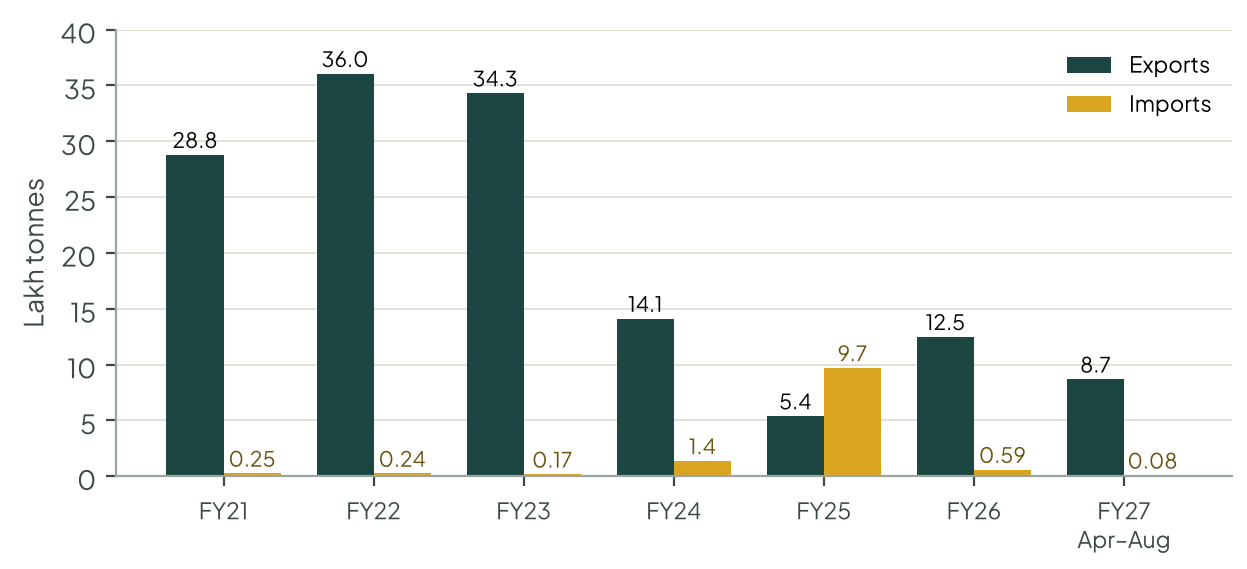
Figure 5. India's maize exports and imports (lakh tonnes, April–March years). DGCI&S via TradeStat (Ministry of Commerce), HS 100590 (maize other than seed); FY27 is April–August 2026, provisional.
Imports are now back. Two buyers have booked 1.04 lakh tonnes of Myanmar maize for loading between 15 November and 15 December: Gujarat Ambuja, 60,000 t into Kandla at $303/t, and Shanthi Feeds and SKM, 44,000 t into Tuticorin at $307/t. That is already 1.8 times the whole of FY26's imports. The starch industry (AISMA) has also asked for a short duty-free import window.
| Booking | Quantity | Price | Port | ≈ ₹/qtl at port* | Local bids today |
|---|---|---|---|---|---|
| Gujarat Ambuja | 60,000 t (4 vessels) | $303/t | Kandla | ₹2,886 | ₹2,800–2,875 (Gujarat) |
| Shanthi Feeds & SKM | 44,000 t (2 vessels) | $307/t | Tuticorin | ₹2,924 | ₹3,400–3,450 (Coimbatore) |
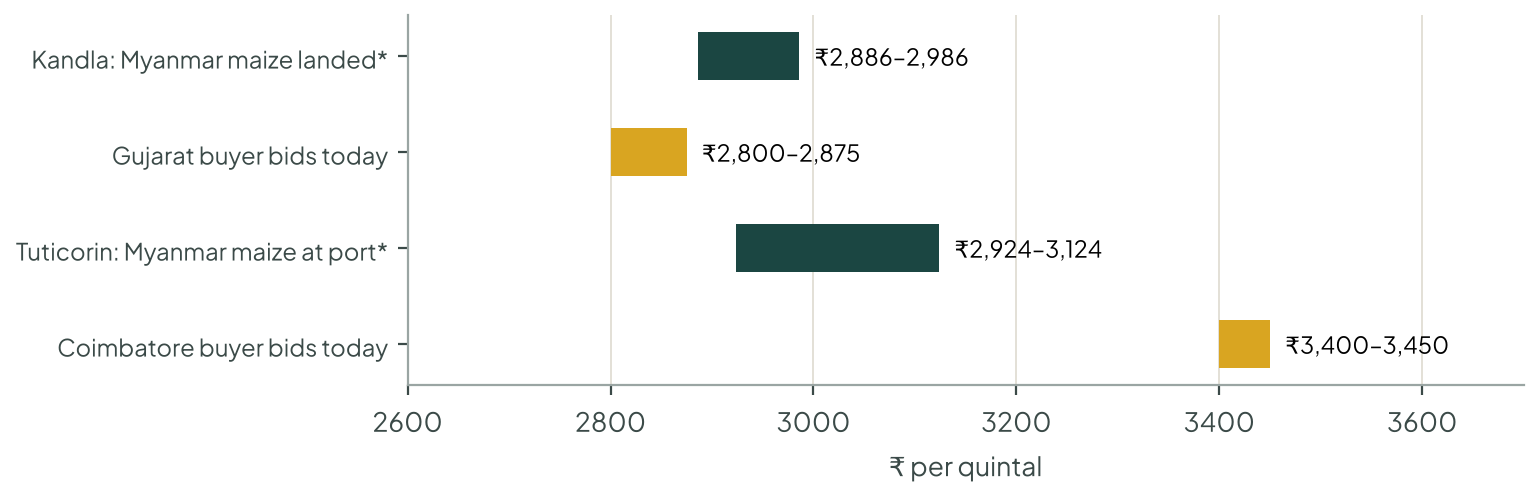
Figure 6. Imported maize vs local bids (₹/quintal).
* At ₹95.24 per US$ (30 Oct 2026), assuming the price includes freight to the Indian port and no import duty; ranges add about ₹100 (Kandla) and ₹200 (Tuticorin to Coimbatore) for handling and transport, FarMart estimates. Bookings: trade sources.
Read-across
Landed Myanmar maize undercuts Tamil Nadu bids by ₹275–325 a quintal, so cargoes arriving in December–January should cap the South near ₹3,100. In Gujarat imports are slightly dearer than local grain and act more as a ceiling around ₹3,000. At the regular 50% duty, imports would not work at today's prices; the duty treatment of these cargoes is still to be confirmed.
What to watch next
- 5 November ethanol bids: how much of the 1,100 crore litres goes to maize vs damaged grain and FCI rice, and whether the maize price is raised.
- Import policy: any duty-free window, as sought by starch and poultry users, would cap prices across the South and West.
- Arrival pace in MP, Rajasthan and Bihar: heavy November arrivals could pull the all-India average lower even as deficit states stay firm.
- North-east monsoon and rabi sowing: TNAU expects Tamil Nadu farm-gate prices around ₹2,700 at harvest; rabi maize in Bihar and Karnataka decides supply after March.
- Myanmar cargoes landing in December–January and whether more bookings follow.
Sources: FarMart Rapid Trade (TradX) buyer bids, 30 Oct 2026; DGCI&S / TradeStat, Ministry of Commerce (HS 100590), FY21–FY26 and Apr–Aug 2026; Agmarknet (Chhindwara, Gulabbagh; monthly state prices to Oct 2026; all-India series); CLFMA kharif estimate (BusinessLine, 23 Oct); DA&FW kharif sowing (AgroSpectrum, 27 Oct); all-India mandi price vs MSP (AgroSpectrum, 27 Oct); OMC ESY 2026-27 tender and corrigendum (ChiniMandi, 29 Oct); AISMA (ChiniMandi, 29 Oct); TNAU forecast (BusinessLine, 28 Oct); mandi reports from Andhra Jyothy, Dainik Bhaskar, Prabhat Khabar, Betul Update, News18, The Cliff News (27–30 Oct); FarMart maize balance sheet; US$/₹ from Twelve Data.
Buyer bids are indicative and change through the day. Crop estimates from industry bodies are not official figures. This report is for information only.