
Turmeric at a Record: The Price of an Empty Pipeline
From flat monsoon-season prices to an all-time record in seven weeks.
- NCDEX December contract record on 6 November
- ₹28,392/qtl
- rise in gatta since June at Erode, Nizamabad and Sangli
- 50–80%
- 2026 output, down from 90–95 lakh in 2025
- 80–85 lakh bags
- April–September export volume against last year
- −2%
Inside the report
The price
Gatta at ₹22,300–23,000 a quintal, with almost no sellers.
Where are the mandis now?The crop
30–35% more area sown, but the rain never followed.
Why is the crop smaller?The arrivals
Erode arrivals have halved since late October.
Where is stock still coming in?The exports
July–September shipments fell 13% behind last year.
Are overseas buyers stepping back?
Turmeric's seven-week sprint to a record
India's turmeric market has gone from flat monsoon-season prices to an all-time record in the space of seven weeks. A crop sown on more land but starved of rain, a pipeline that has run almost empty, and stockists buying ahead of the wedding and Ramzan season have pushed prices to levels the trade has never seen.
01The price
Where the market stands
Turmeric is at record prices with almost no sellers. Since June, gatta has climbed 50–80% across the three big mandis, spot trade has thinned to a trickle, stockists are paying whatever is asked, and the trade expects only a short correction before prices firm again.
- Producing-centre gatta is at ₹22,300–23,000 per quintal as of 20 November: Erode at ₹22,300, Nizamabad at ₹23,000 and Sangli at ₹23,000. Sangli set a fresh high this week, Erode edged up and Nizamabad held its 12 November level, with no sign yet of the correction in the mandis.
- The NCDEX December turmeric contract hit a record ₹28,392/qtl on 6 November, then dipped to ₹27,258/qtl on 20 November.
- Delhi single-polish gatta was quoted at ₹24,500–24,600 per quintal on 20 November.
- Spot trade is thin: mandis have reopened fully after the Diwali closures and arrivals have improved a little, but buyers are still taking any stock on offer.
- Traders expect a short correction after a one-sided rally, but low stocks and crop damage keep the underlying view firm.
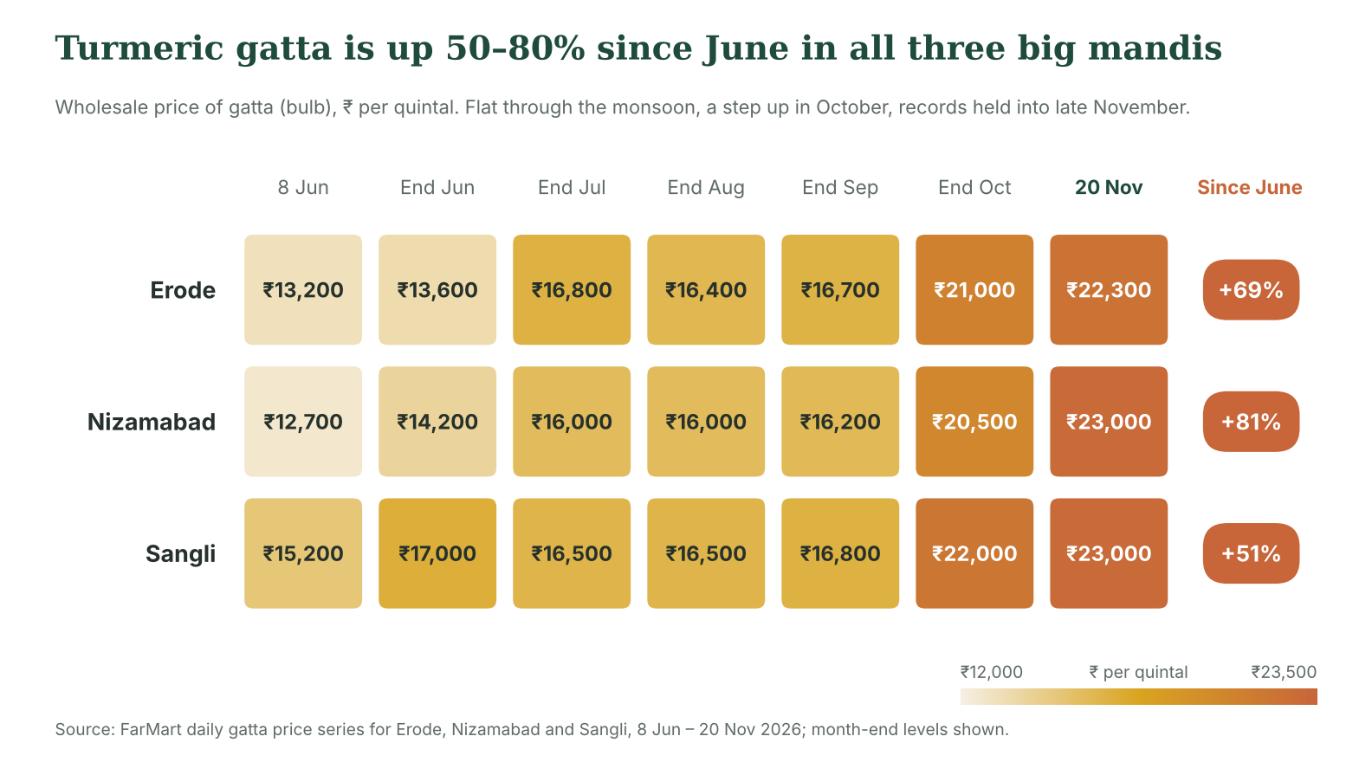
Source: FarMart daily gatta price series for Erode, Nizamabad and Sangli, 8 Jun – 20 Nov 2026; month-end levels shown.
Back to overview02The crop
Why a smaller crop on a bigger area
Turmeric was sown on 30–35% more land this season, but the rain never followed the planting, and traders now expect a second consecutive short crop. Output had already slipped from 90–95 lakh bags in 2025 to 80–85 lakh in 2026.
- Maharashtra (40–45% of national output): drought declared; crop withering reported in Hingoli, Nanded and Basmat.
- Karnataka and Telangana: severe drought; Nizamabad output now seen below forecast.
- Tamil Nadu: water scarcity around Erode.
- Andhra Pradesh: Cyclones Arnab and Murasu ten days apart; heavy rain on standing turmeric.
- Pipeline stock is low, and Nizamabad-line arrivals begin only in late January–early February 2027.
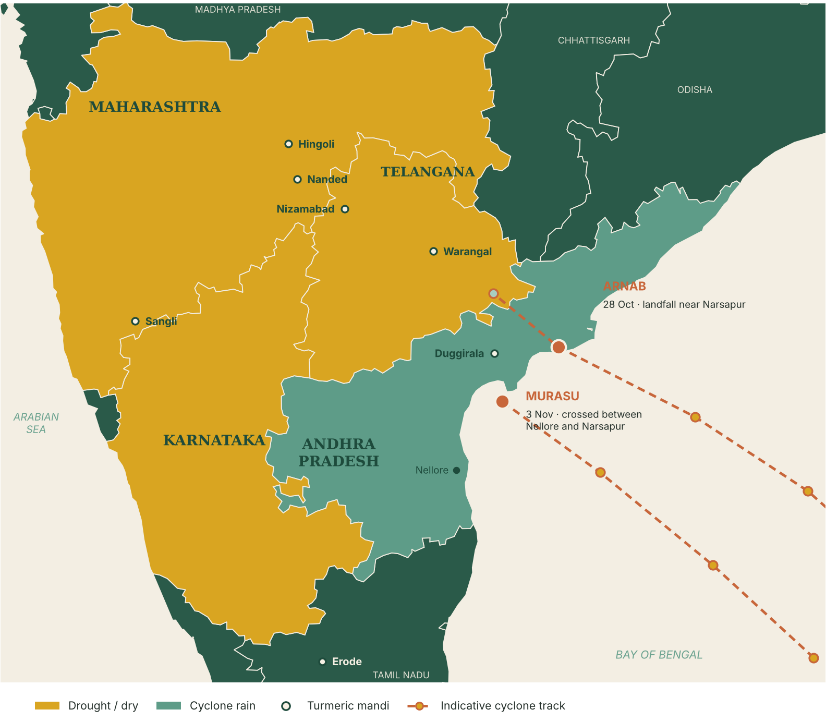
Weather stress on the 2026-27 turmeric crop.
Back to overviewDemand: running ahead of supply
- Stockists and powder makers are buying aggressively and taking stock at any price.
- November–December is peak consumption as the wedding season follows the festivals; export demand is firm, and Ramzan in January should lift it further.
03The arrivals
Arrivals are drying up
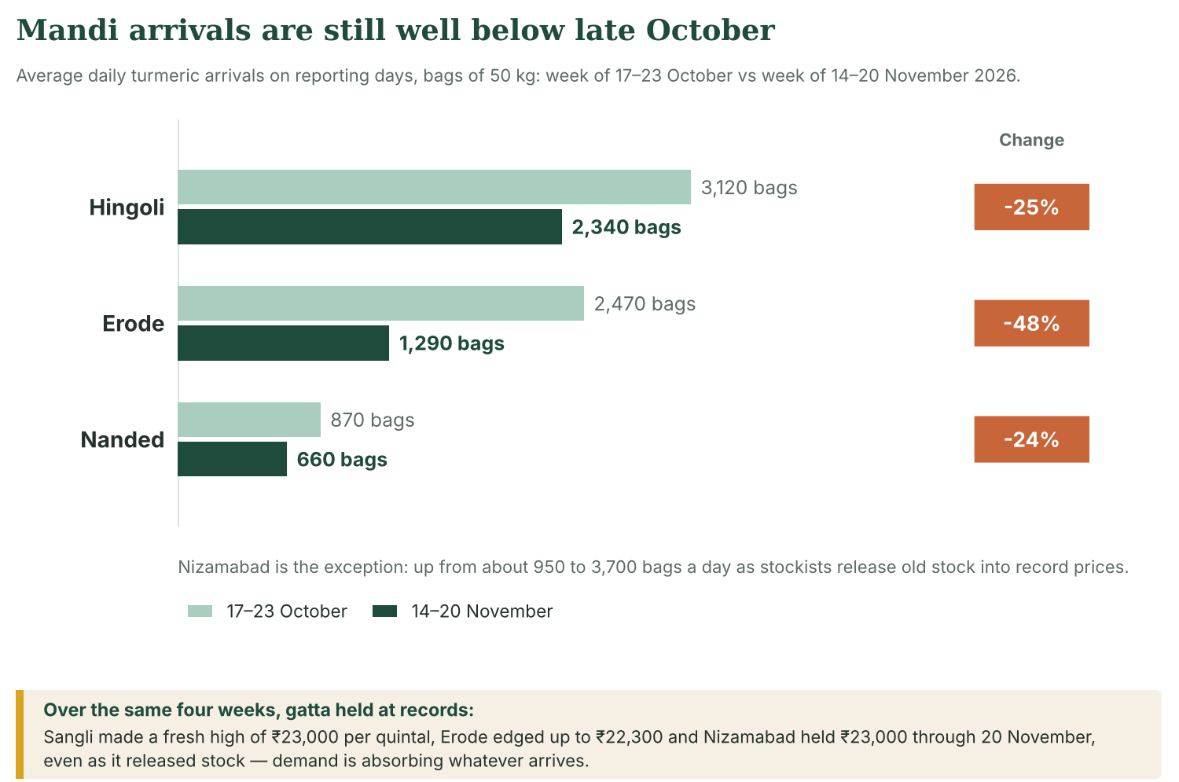
- Four weeks on from late October, average daily arrivals at Erode have roughly halved and Hingoli and Nanded are down about a quarter.
- Nizamabad is the exception: arrivals there have jumped several-fold since Diwali as stockists on the Telangana line release old stock into record prices. The squeeze is in the Maharashtra and Tamil Nadu lines, not Telangana.
- The Diwali closures explained the first dip, but a fortnight after mandis reopened, arrivals in Maharashtra mandis and Erode have not recovered: farmers and traders simply have little old stock left to bring in.
- Demand is absorbing whatever arrives: even with Nizamabad’s extra supply, gatta held at records through 20 November.
- Until the Nizamabad new crop starts arriving in late January–early February, thin arrivals outside Telangana remain the single biggest reason prices are unlikely to fall far.
04The exports
Exports: steady for three years, now slipping
- India's turmeric export volumes stepped up through 2023-24 and held near that level for three years; 2026-27 has broken the pattern, with April–September running 2% behind last year.
- The story this year is in timing and price. April–June ran 8% ahead of last year and earnings rose about a fifth to ₹875.70 crore, because buyers were paying up for the new-season price.
- Then the rally began to bite: July–September shipments fell 13% behind last year, and September alone was down 14%, the third straight month below last year and the clearest sign of overseas buyers stepping back.
- Whether volumes recover now depends on Ramzan demand from the Gulf and South-East Asia in December–January, and on whether record Indian prices give other origins room to win share.
- India's dominance in the trade means importers have few places to switch at scale, so volume has bent rather than broken, and 2026-27 export value should still beat last year's ₹2,887.18 crore on price alone.
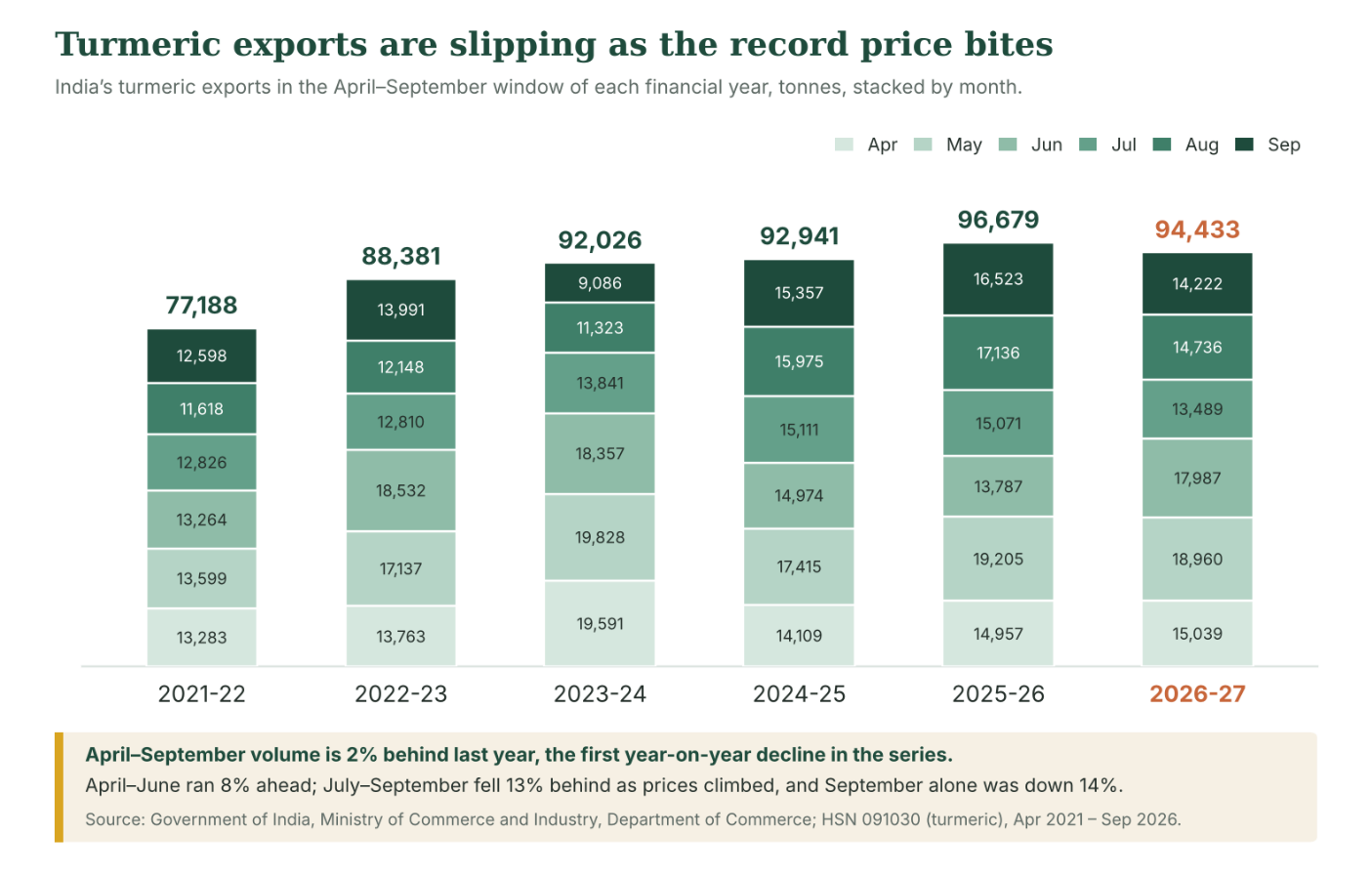
Source: Government of India, Ministry of Commerce and Industry, Department of Commerce; HSN 091030 (turmeric), Apr 2021 – Sep 2026.
Back to overviewWhat it adds up to
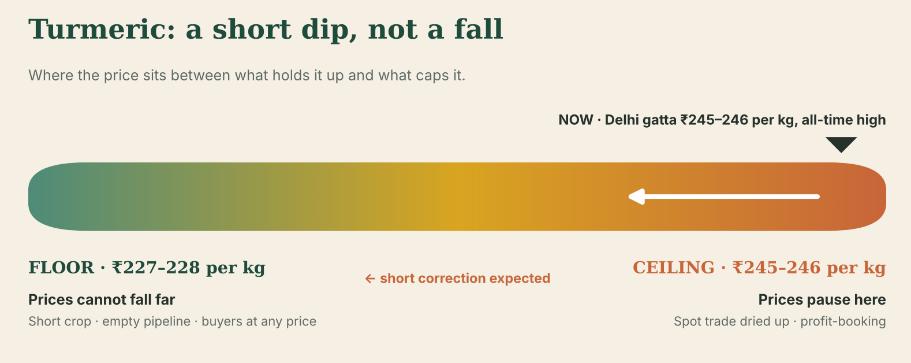
- Turmeric has a floor and a ceiling. The floor is a short crop for the second year running, low pipeline stocks and buyers paying any price into the peak-demand months.
- The ceiling is price itself: spot trade is thin at ₹245 per kg in Delhi, and traders expect profit-booking to force a short correction after a one-sided rally.
- With the new crop three months away, the trade expects prices to firm again after any dip.
What to watch next
- Profit-booking: whether the expected correction arrives, and how deep it goes before stockists step back in.
- Standing crop: cyclone damage in Andhra Pradesh and drought stress in Maharashtra, Karnataka and Telangana.
- Ramzan buying: export enquiries from December for January demand.
- New-crop arrivals: Nizamabad line from late January–early February; the first yield reports will set the 2027 price.