
Cyclone Arnab: Andhra's Kharif Lost, Rabi at Risk
- crops submerged across coastal Andhra Pradesh
- 3.52 lakh ha
- farmers affected across eight districts
- 5.42 lakh
- paddy lost, about 6% of AP's kharif crop
- ~5.3 LMT
- AP dams full, against 88% a year ago
- 28%
Inside the report
The storm
A dated path from the Bay to landfall near Narsapur, 25–28 October.
Where did it go next?The damage
3.52 lakh ha under water; the count grew 57% in a week.
Final figure and farmers hit?Yield loss
Three paddy stages took the hit; one cannot recover.
Which stage, and how much?Empty dams
AP's dams are 28% full against 88% a year ago.
Why that caps the rabi crop?
01The storm
Arnab: where it came from and where it went
- Arnab, a post-monsoon Bay of Bengal cyclone, formed as a low-pressure area over the Bay around 25 October.
- After IMD issued its first alert, it strengthened into a severe cyclonic storm as it moved west-north-west, and made landfall near Narsapur in West Godavari on 28 October, the heart of the Godavari delta.
- It weakened quickly inland and has dissipated, with damage reported in Odisha as well as Andhra Pradesh.
- The storm itself is over, but a second cyclone, Murasu, formed over the same waters on 2 November and was forecast to cross the coast between Nellore and Narsapur in the early hours of 3 November.
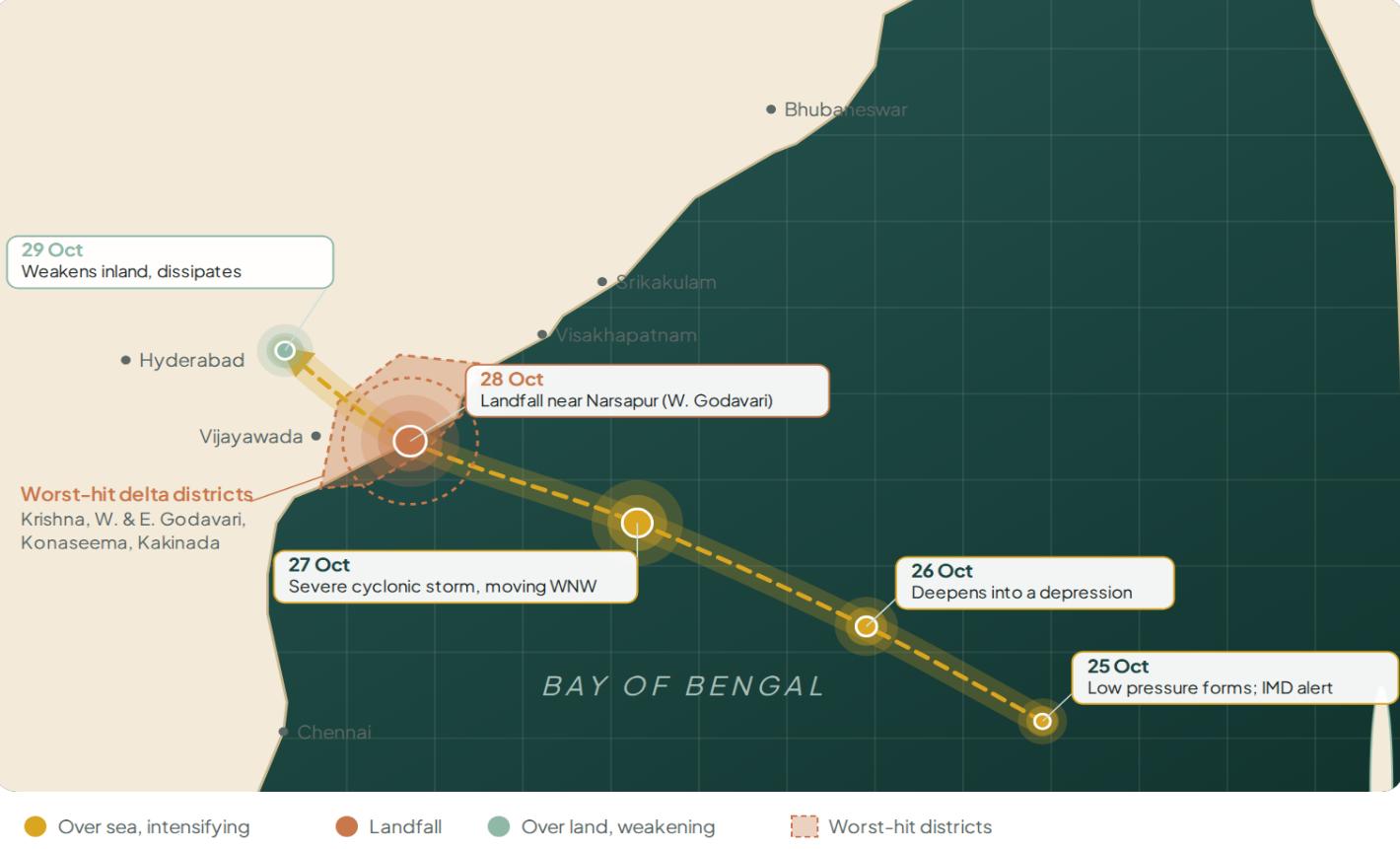
Cyclone Arnab's path to the Andhra coast. Indicative positions placed from IMD's alerts and bulletins, 25–29 Oct 2026.
Back to overview02The damage
The event and the scale of damage
- Cyclone Arnab tracked toward the Andhra coast, made landfall and weakened inland, leaving heavy rain and flooding across eight districts.
- The timing was the worst the kharif calendar offers: delta paddy stood between booting and grain formation, coconut, oil palm and banana were carrying fruit, and rice-fallow pulse sowing was weeks away.
- The Godavari delta took the brunt, with West Godavari, Konaseema, Kakinada and East Godavari joined by Krishna as the five worst-hit districts.
- Srikakulam in the north reports a smaller, more mixed loss across paddy, pulses and cotton.
- Odisha was hit too: Arnab's rain and wind reached southern Odisha, and the state government has announced a special relief package for affected families. No crop-loss figures for Odisha are available yet; its kharif paddy is at a similar stage and should be watched.
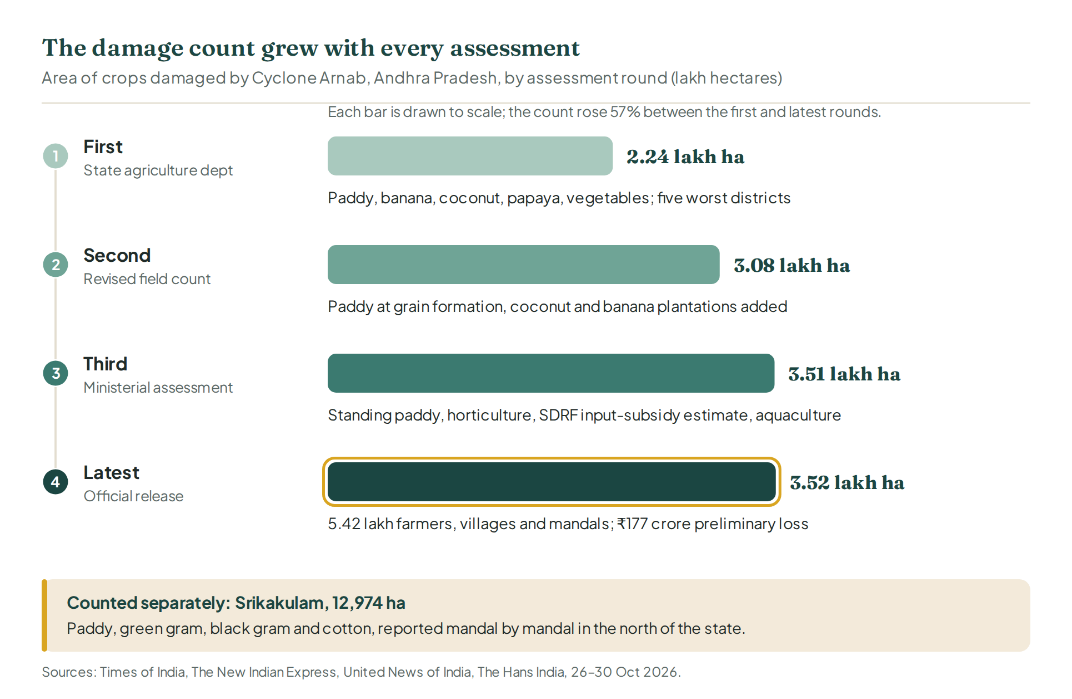
Two loss figures, two meanings
₹177 crore is the agriculture department's preliminary input-subsidy estimate under SDRF norms, which covers replanting cost, not lost output. The Chief Minister's initial estimate of the state's total losses across all sectors is about ₹4,600 crore, and he has said it could rise once the full extent of damage is known.
03Yield loss
Yield and production loss: about 6% of Andhra's kharif paddy
- Our central estimate is a loss of about 5.3 lakh tonnes of paddy (3.5 lakh tonnes of rice), roughly 6% of Andhra Pradesh's kharif paddy output and about 0.3% of India's kharif rice.
- Flowering paddy is the stage that cannot recover: two to three days of submergence causes spikelet sterility that no later management repairs.
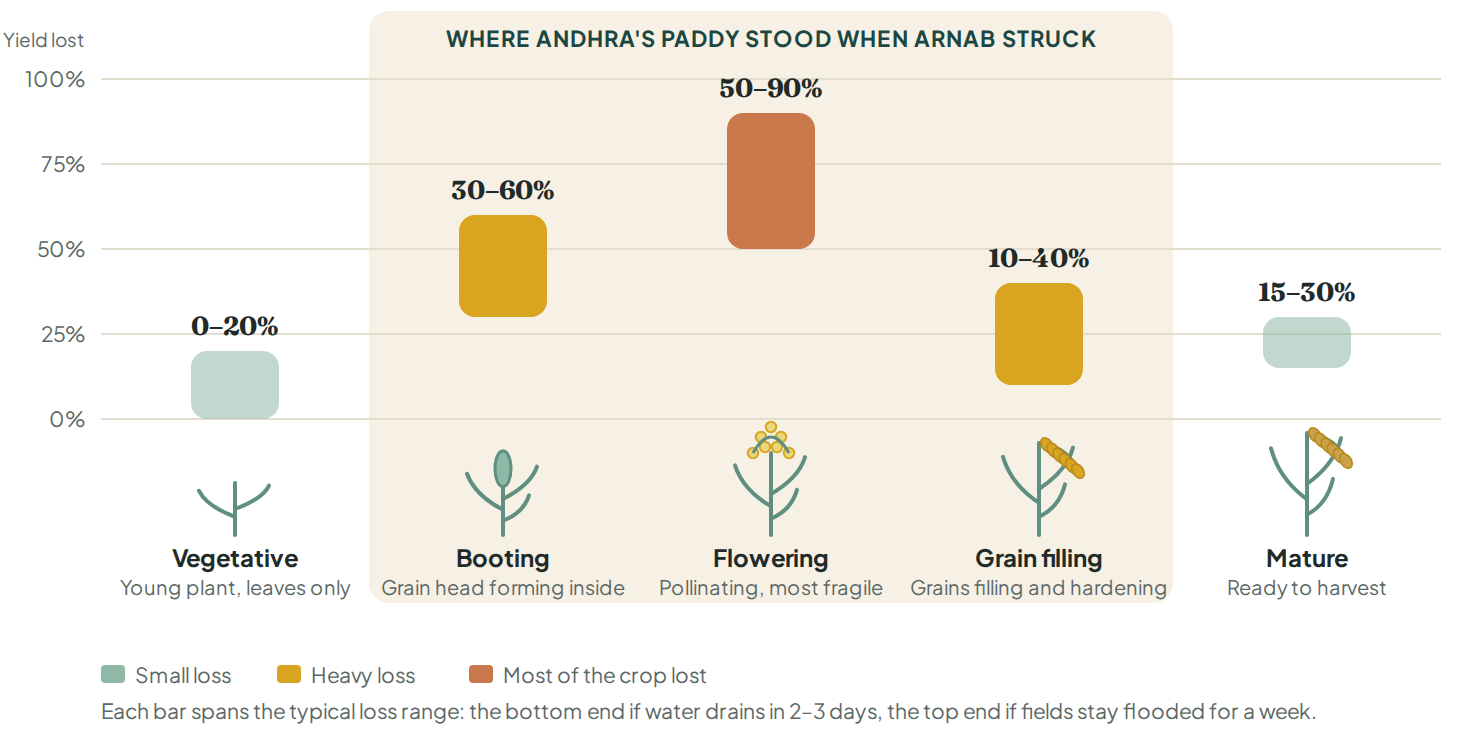
Note on the percentages. These are assumed ranges, not field measurements, taken from standard rice agronomy on flood and lodging damage (IRRI and Indian agricultural university research). Young plants regrow after flooding, so losses are small; at booting and flowering the grain is being formed and pollinated, so a few days underwater destroys most of it; once grain has formed, flooding flattens plants and spoils quality more than yield. The low end of each range assumes water drains in 2–3 days, the high end a week or more.
Back to overviewKnock-on effects: rabi sowing, procurement, prices and water
Beyond the lost tonnage, Arnab's knock-on effects run through rabi sowing, procurement, regional prices, farm finances and coastal aquaculture, and they land on a state whose reservoirs stood at 28% of capacity as on 22 October, in a southern region at 42%.
- Rabi sowing. Delta fields need 2 to 3 weeks to drain, so rabi (dalwa) paddy nurseries and rice-fallow pulse sowing slip by the same margin, pushing the rabi harvest toward April heat.
- Pests and disease. Lodged, wet paddy invites brown planthopper, bacterial leaf blight and sheath blight; rodents follow floods; harvested paddy stacked in the open sprouts and molds.
- Procurement. Discolored and sprouted grain fails FAQ norms. After Michaung (2023) and Montha (2025) the Centre relaxed norms at the state's request; a similar request is likely within weeks.
- Prices. Rice: no spike, stocks are ample. Coconut, banana, papaya and vegetables: local and regional spikes for one to three months, with coconut tightness lasting longer.
- Exports. Shrimp from the Krishna–Godavari belt, India's largest producing region, faces pond losses, restocking costs and disease risk; rice and basmati exports will remain unaffected.
- Farm finances. SDRF input subsidy replaces a fraction of input cost, not lost output; delayed payments, higher borrowing and insurance claims through APAIMS follow.
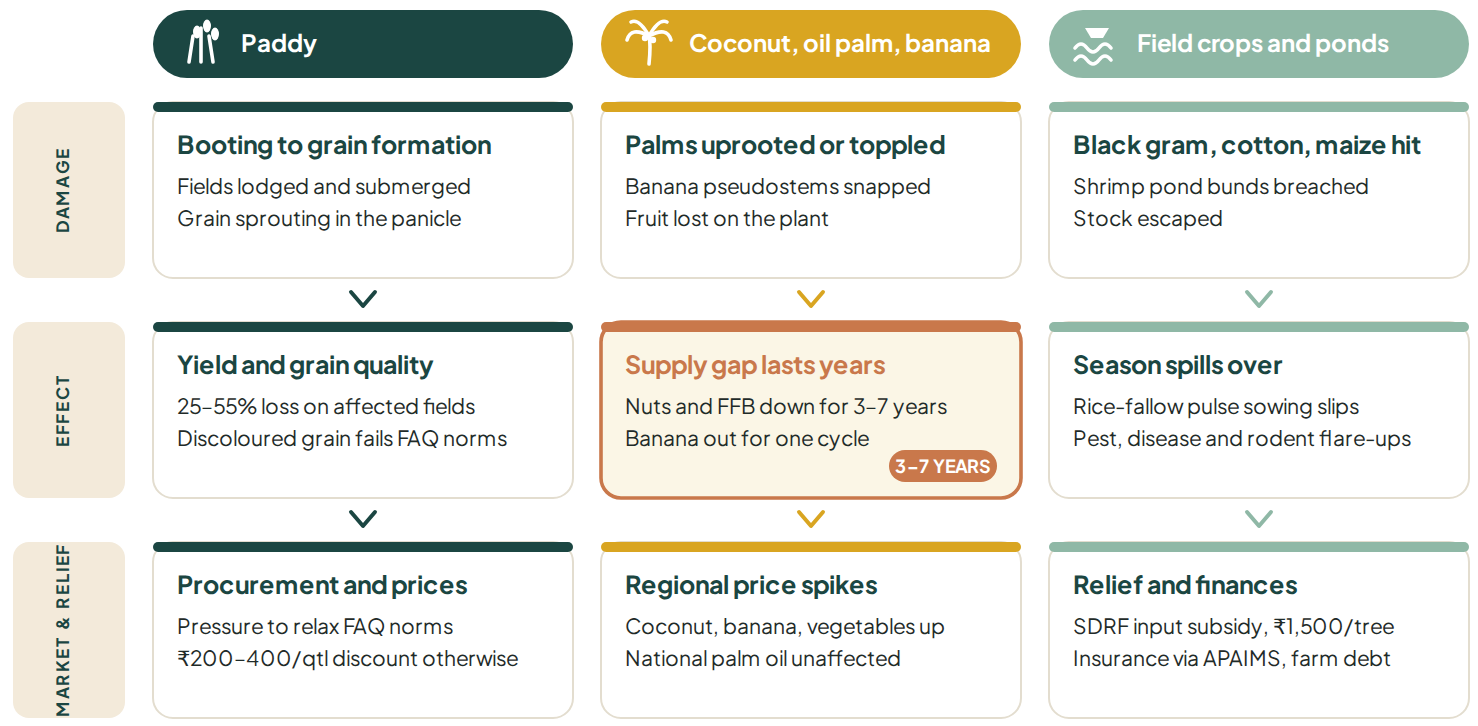
The paddy path resolves within one season; the horticulture path in the middle outlasts the relief package.
04Empty dams
Empty dams: the second blow
- Arnab's rain fell near the coast and drained into the sea within days. It did not fill Andhra's big dams, because they sit hundreds of kilometers inland on the Krishna and Pennar rivers and fill from rain in Maharashtra, Karnataka and Telangana, where the monsoon failed this year.
- Today those dams are only about a quarter full (28%), against 88% in the same week last year.
- This matters because after any cyclone, farmers count on the rabi crop to make up for a lost kharif. The fields dry out, they replant, and the rabi paddy covers the loss.
- But rabi paddy grows on canal water released from the dams, not on rain. So this year the state takes a double hit.
- Godavari delta: the cyclone destroyed the kharif crop, but rabi can still be grown, because the Godavari canals run on river flow and do not depend on a dam.
- Krishna delta, Nellore and Rayalaseema: the kharif crop survived, but the dams that feed their canals are nearly empty, so water for rabi will be rationed or refused.
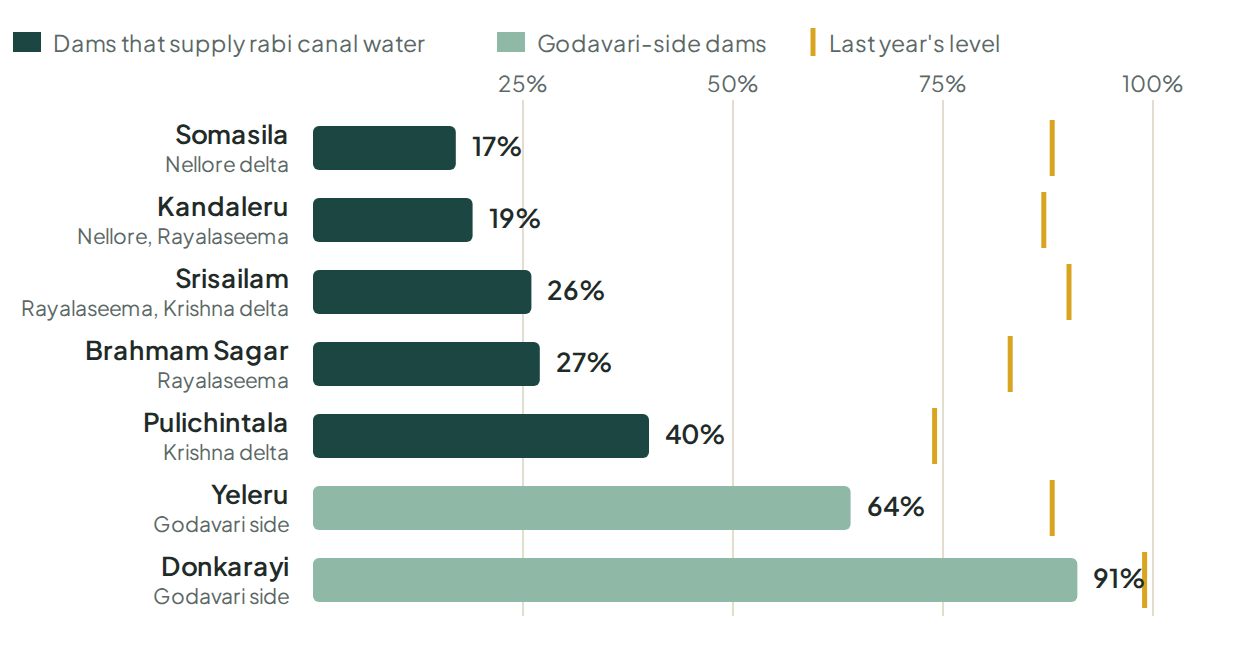
Source: CWC Weekly Reservoir Storage Bulletin, 22 Oct 2026. The five dark green bars are the dams that supply rabi canal water to the Krishna delta, Nellore and Rayalaseema; each of them is less than half full. The two light green bars, Yeleru and Donkarayi, sit on the Godavari side and are healthy. The gold line on each bar marks where the dam stood in the same week last year.
Back to overviewWhat it adds up to
Cyclone Arnab has cost Andhra Pradesh about 6% of its kharif paddy, concentrated in five delta districts, and years of income from uprooted coconut and oil palm. It has not changed India's rice supply. The bigger worry is what follows: a second cyclone, Murasu, was forecast to cross the same coast within a week, and the dams that would normally water a recovery rabi crop are a quarter full, so the state faces a thin season on both sides of the calendar. For the market, that means less rice out of Andhra Pradesh in both seasons, lower FCI procurement from the state, tighter Sona Masoori supply from March 2027, and higher coconut and vegetable prices in the region for months.
What to watch next
- Final crop-loss count (mid-November): the state's field survey sets the real paddy loss and the compensation bill.
- Procurement rules: whether the Centre relaxes quality norms so wet, discolored paddy still fetches MSP.
- Central relief: the central team's report and how much NDRF money follows.
- Rabi sowing (December): how much of the Krishna delta and Rayalaseema actually gets canal water.
- Cyclone Murasu (3 November): where it crossed between Nellore and Narsapur, how much rain fell on draining delta fields, and whether the Pennar dams gained water.
- Odisha's damage count: the state has announced relief but no crop figures yet.